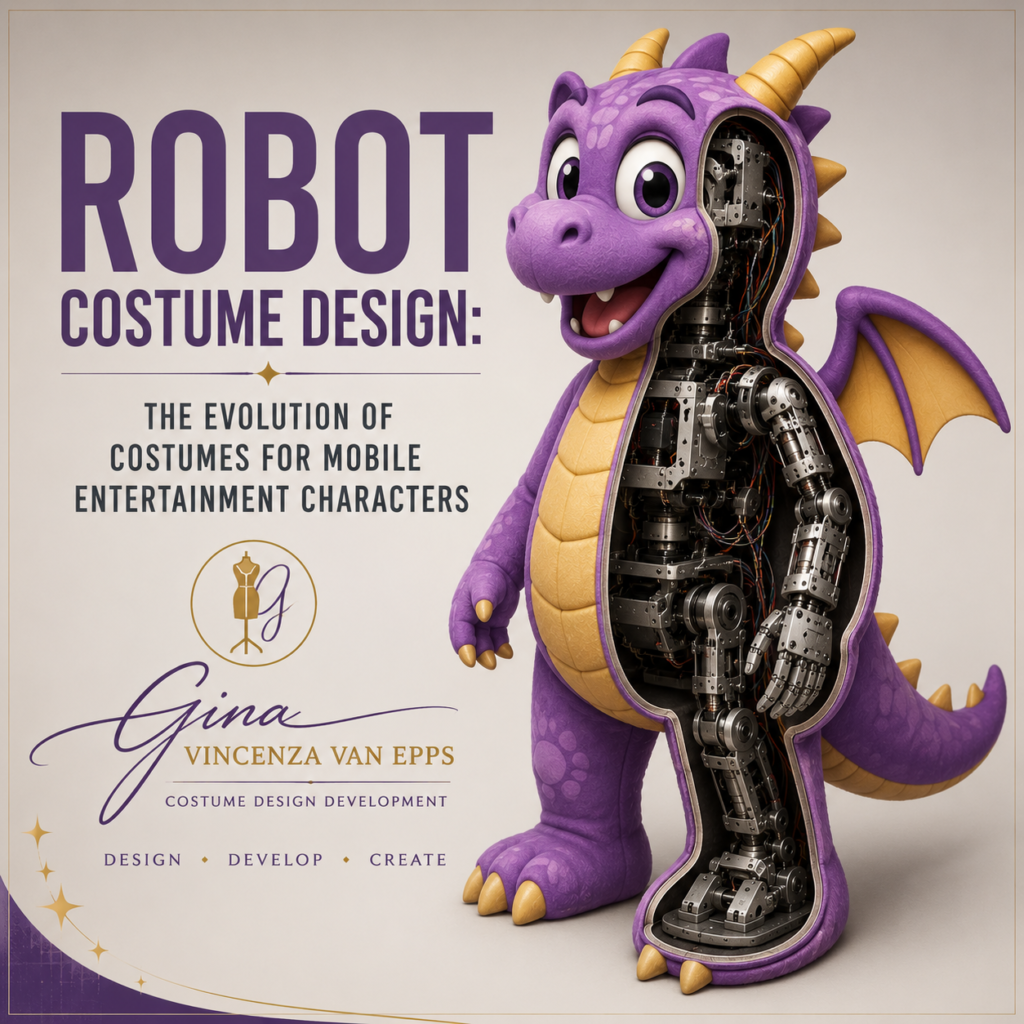
For decades, costume and character design in entertainment have been built around a relatively simple assumption: the character has a performer, a stage or a fixed environment.
That assumption is beginning to change.
I recently became part of a multidisciplinary design-development team working on a project that is giving me my first experience designing costume for a mobile robotic character. The project is being developed for the robotics and entertainment industry and is intended to be showcased internationally within the theme park industry.
I can’t share the character or the project details yet, but I can talk about what the experience is teaching me.
And I think it points toward an important evolution in costume design.
From Animatronics to Characters That Move
When I think about the history of entertainment characters, I think about attractions like Disney’s Country Bear Jamboree and Hall of Presidents, where sophisticated Audio-Animatronics created the illusion of living characters performing within a carefully constructed environment.
Chuck E. Cheese brought another version of the animatronic character into family entertainment, combining mechanical characters with food, games and live entertainment.
More recently, properties such as Five Nights at Freddy’s have made animatronic characters part of contemporary horror and gaming culture. The mechanical character itself can become part of the story.
But there is a fundamental difference between a character that performs in a fixed location and a character that can move through the environment.
That difference is where costume design starts to change.
When the Character Walks Off the Stage
A stationary animatronic can be designed around its location.
A mobile robotic character has to be designed around movement.
It may need to navigate a show environment, participate in a parade, interact with guests, appear at a meet-and-greet or move through an immersive experience.
Suddenly, the costume has to work with the machine underneath it.
Weight matters.
Balance matters.
Ventilation matters.
Articulation matters.
Clearance matters.
Access for maintenance matters.
A beautiful costume that interferes with a motor, restricts a joint or adds too much weight in the wrong location isn’t a successful costume.
The costume has to become part of the character’s functional ecosystem.
That is a very different design problem from creating an exterior for a stationary figure.
Designing Around the Machine
This is one of the things I am finding most fascinating about my current project.
As a costume designer, I am accustomed to designing around the human body. I think about anatomy, movement, range of motion, heat, comfort, balance and the practical realities of a performer wearing the costume.
With a robotic character, the body is different.
There may be motors, batteries, electronics, sensors, mechanical joints and other systems that determine what the character can do.
The costume has to accommodate all of that.
And because the character moves, the costume has to move with it.
This requires a much more integrated development process.
I was brought into this project by a prop-development company that specializes in creating physical character and prop components using technologies including 3D printing, casting and more traditional fabrication methods. I am working alongside a broader multidisciplinary team developing the character from several different directions.
That collaboration is giving me a firsthand look at something I believe will become increasingly common:
costume designers working directly within robotics and advanced character-development teams.
We aren’t simply dressing a finished robot.
We are developing the character together.
The Material Question
There is another part of this evolution that I think deserves more attention.
When a character is stationary and contained within a controlled attraction, the material considerations are different from those of a character that moves through a public environment.
A mobile character may be touched, photographed, hugged, cleaned, transported, repaired and handled repeatedly.
That means material selection isn’t only about appearance.
It is also about performance, durability, maintenance and human interaction.
And this is where I believe costume design is going to have to become increasingly sophisticated about material composition and chemical exposure.
PFAS is one example.
As regulations increasingly restrict intentionally added PFAS in certain textile and apparel applications, and as we learn more about potential human and environmental exposure pathways, costume designers need to understand that selecting a fabric or finish can involve considerations beyond color, texture and performance.
That doesn’t mean every synthetic fabric contains PFAS. It doesn’t.
It means that material claims and material composition increasingly deserve verification rather than assumption.
For characters designed to operate in close proximity to people, I think that conversation belongs at the design-development table.
Not after the costume has already been built.
Where Costume Design Goes Next
Robotics is already moving beyond factories and laboratories.
We are seeing robots delivering food on city sidewalks, robots being developed for public-service applications and increasingly sophisticated machines being introduced into environments where humans live, work and play.
Entertainment may be one of the most interesting places to watch this transition.
Theme parks have spent decades teaching audiences to believe that mechanical characters are alive.
The next step is different.
What happens when the character can actually walk away from the stage?
What happens when that character can enter a parade?
A live show?
A meet-and-greet?
An immersive environment?
A crowd?
That is where costume design becomes something more than visual storytelling.
It becomes part of the engineering and performance problem.
As robotic characters move from the stage into the world, costume design has to evolve with them. I’m excited to be exploring that intersection of costume, character and robotics firsthand.
If you’re developing a mobile robotic character, interactive entertainment experience or the next generation of technology-driven characters, let’s talk about how costume design development can help bring that character to life.
Gina Vincenza Van Epps – Costume Design Developer for the Next Generation